
Padel vs pickleball: what actually makes them different
· 3 min read
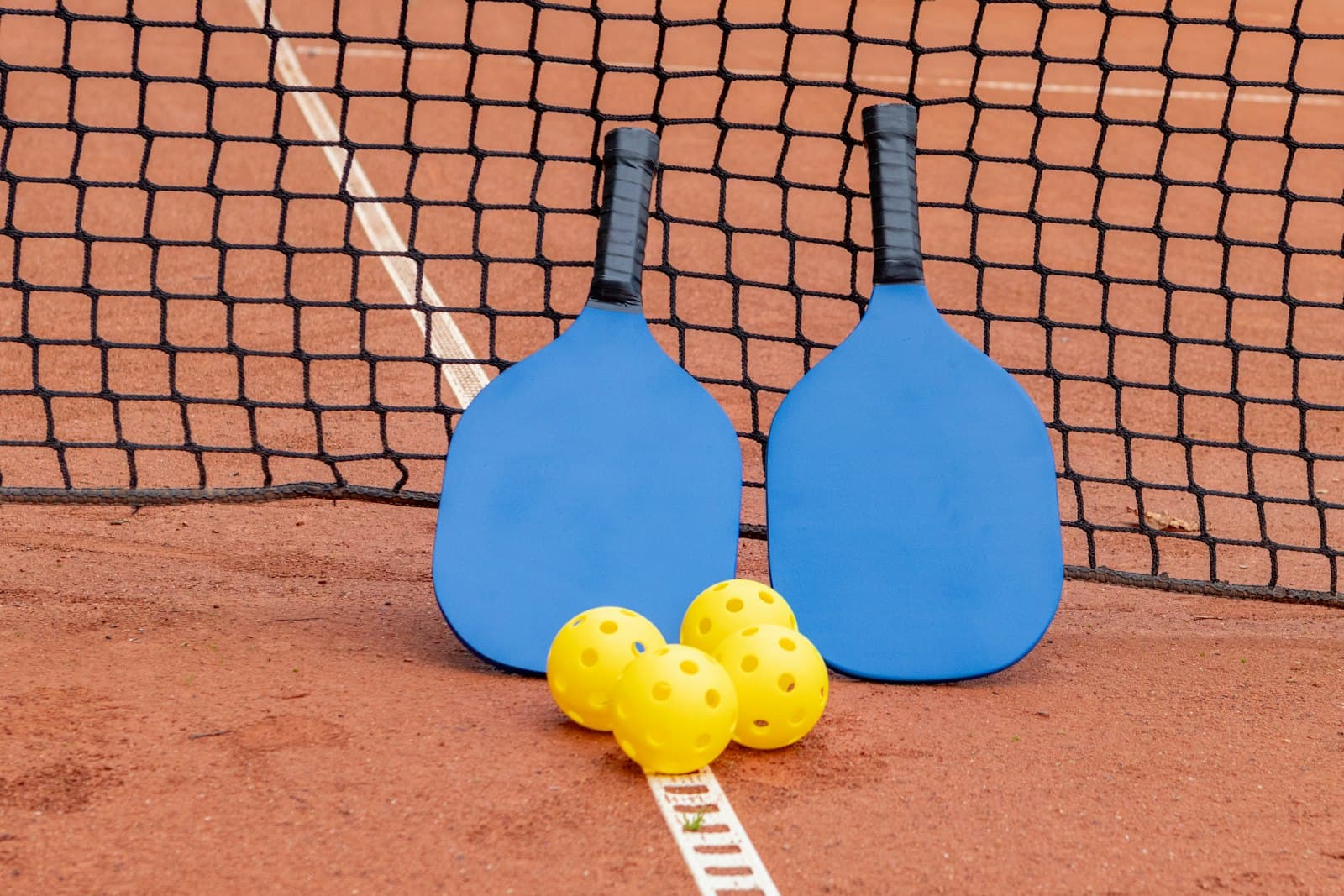
They look similar — solid stringless bats, small courts, doubles — but they are different sports. Padel is played off enclosed glass walls with a pressurised ball; pickleball is played on an open badminton-sized court with a perforated plastic ball.
People coming from tennis tend to lump padel and pickleball together, and from a distance the confusion is fair: both are played with a solid bat that has no strings, both are dominated by doubles, and both use a court much smaller than a tennis court. Underneath that, almost everything is different — including how the equipment has to be built.
The court is the biggest difference
A padel court is enclosed. It is 20m by 10m, surrounded by glass and mesh, and the walls are in play — the ball can be taken off the back glass, which is why rallies last far longer than the court size suggests. Learning to use the wall is most of the learning curve.
A pickleball court is open, and much smaller: 20ft by 44ft, the same footprint as a doubles badminton court. There are no walls, so a ball that passes you is gone. The defining feature instead is the non-volley zone — the "kitchen" — a seven-foot strip either side of the net where you cannot hit the ball out of the air.
The ball changes everything
Padel uses a ball that looks like a tennis ball and is slightly less pressurised. It bounces high and fast, and it holds pace off the glass. Pickleball uses a rigid perforated plastic ball that is far lighter, slows quickly through the air, and barely bounces by comparison.
That single difference explains most of the equipment divergence. A padel racket has to absorb and redirect a heavy, fast ball. A pickleball paddle has to generate pace against a light one that does very little on its own.
How the equipment differs
| Padel racket | Carbon or fibreglass face over an EVA foam core, around 38mm thick, 350-380g, perforated, with a wrist strap. |
|---|---|
| Pickleball paddle | Carbon or fibreglass face over a polypropylene honeycomb core, 13-16mm thick, considerably lighter, solid face, no holes. |
| Why the core differs | EVA foam handles the repeated impact of a pressurised ball; honeycomb returns energy to a ball that carries little of its own. |
| Why the holes | Padel rackets are perforated to cut air resistance on a heavier, faster swing. Pickleball paddles are not. |
Serving and scoring
Both sports serve underarm, which is part of why both are easy to pick up. Padel serves must bounce before being struck and are played into the diagonal box, with tennis scoring — 15, 30, 40, game. Pickleball serves are hit on the full without bouncing, and in most formats only the serving side can score, so games swing on holding serve.
Which is growing faster?
Both are growing quickly, in different places. Pickleball has expanded fastest in North America, helped by how cheap it is to convert existing tennis and badminton courts. Padel is strongest in Spain and Latin America and has spread rapidly through Europe and the Middle East, though it needs purpose-built courts, which slows expansion and raises the cost of entry.
For a brand deciding which to stock, that geography usually matters more than the sports themselves. Both use the same manufacturing base, so carrying the two is not the jump it appears to be — the face materials and finishing processes overlap almost entirely, and only the core and mould differ.